

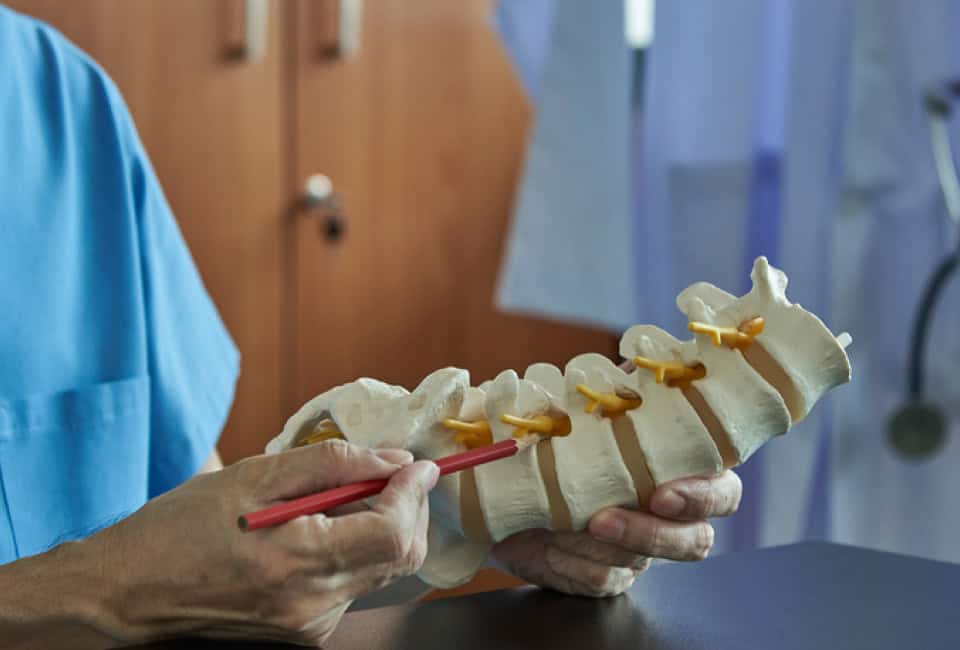
Spine-related back or neck pain is extremely common, with as many as 80% of American adults experiencing back pain at some point during their lives and roughly 200,000 patients undergoing surgery for cervical (neck) degenerative disc disease each year alone. When symptoms are caused by a damaged spinal disc and conservative treatments fail to provide adequate relief, artificial disc replacement (ADR) provides an advanced surgical option designed to relieve pain while preserving natural spinal movement.
What Is Artificial Disc Replacement and How Does It Work?
Artificial disc replacement is a procedure for removing a worn or diseased spinal disc and replacing it with a specialized implant designed to function like the original. Healthy spinal discs sit between the bones of the spine and serve to provide cushioning, stability, and flexibility. Over time, injury or age-related degeneration can cause a disc to lose height, dry out, or press on nearby nerves, which can lead to pain, weakness, or reduced mobility.
During ADR surgery, the damaged disc is carefully removed to relieve pressure on the spinal cord and nearby nerves. Then, the artificial disc is inserted into the damaged disc’s place to restore normal spacing between the vertebrae. Unlike a traditional spinal fusion procedure, which permanently joins two bones together, ADR is intended to restore proper mobility of the spinal segment.
Disc replacement for the lumbar spine was first approved by the United States (U.S.) Food and Drug Administration (FDA) in 2005, followed by cervical disc replacement in 2007. Since then, extensive clinical research and long-term studies have demonstrated consistent safety, durability, and effectiveness for appropriately selected patients.
Conditions Treated With Artificial Disc Replacement
An artificial disc replacement may be considered for any spinal condition that results from a single damaged disc causing ongoing pain or nerve irritation. These issues can appear gradually as discs lose strength and integrity. Over time, as the condition worsens, this can interfere with the normal function of the spine and limit mobility or overall quality of life.
Some of the conditions that may be treated with ADR include:
- Arthritis: Wear-and-tear changes in the joints of the spine that may cause inflammation, stiffness, and discomfort.
- Degenerative disc disease: A condition where a spinal disc gradually deteriorates over time, which can lead to chronic neck or back pain.
- Degenerative scoliosis: An adult-onset curvature of the spine caused by uneven disc and joint wear.
- Isthmic or degenerative spondylolisthesis: A condition where one vertebra slips forward over another, sometimes leading to nerve compression or instability.
- Herniated or bulging disc: Occurs when the inner portion of a disc pushes through the outer layer, which may irritate or compress nearby nerves.
In general, ADR may be considered when symptoms are clearly linked to one or two affected discs and the rest of the spine remains stable and healthy.
Am I a Candidate for ADR Surgery?
ADR surgery isn’t appropriate for every spinal condition or every patient. Your doctor can provide the most personalized guidance and recommendations for you. However, the best candidates are typically patients with persistent neck or back pain traced to one or two spinal discs that have not improved with conservative care options, such as physical therapy, medications, or spinal injections. In general, good candidates for ADR surgery are people who:
- Have confirmed disc damage in imaging studies, such as MRI or CT scans
- Experience ongoing pain, numbness, or weakness related to nerve irritation
- Have relatively healthy surrounding joints and bones
- Do not have significant spinal instability or severe deformity
- Are in good overall health for surgery
A thorough consultation with a spine specialist is necessary to review your medical history, symptoms, imaging results, and treatment goals. They will help you determine whether an ADR surgery offers the safest and most effective path toward lasting relief.
The Artificial Disc Replacement Procedure: What To Expect
An artificial disc replacement procedure is usually performed in a hospital or specialized center under general anesthesia, which means you’ll be asleep the whole time and feel no pain. The exact approach depends on whether the affected disc is in the neck (cervical spine), middle back (thoracic spine), or lower back (lumbar spine), but the overall steps are similar.
In total, the ADR procedure takes about one to two hours. First, the surgeon makes small, carefully placed cuts to access the affected region of the spine. They will gently move aside muscles and soft tissues before removing the damaging disc along with any material pressing on nerves or the spinal cord. The surrounding bone is prepared to ensure there is room for the implant, and, finally, the artificial disc is placed in the correct position.
For cervical procedures, the spine may be accessed through the front of the neck, which allows direct access to the disc with minimal disruption to surrounding structures.
Like with any operation, ADR carries some risk. However, serious complications are uncommon when performed by an experienced spine surgeon. Possible risks and complications may include:
- Infection at the surgical site or around the implant
- Bleeding or blood clots in the legs after surgery
- Injury to nearby nerves or surrounding structures
- Movement, loosening, or wear of the artificial disc over time
- Implant failure, fracture, or improper positioning
- Stiffness or persistent pain after surgery
Recovery Timeline and Returning to Normal Activities
You’ll be monitored throughout and after the procedure, as you recover from anesthesia. Many people are able to walk the same day. Depending on your procedure, you may be able to return home the same day or after spending one night in the hospital. Early movement is encouraged to promote circulation and reduce stiffness.
Recovery is typically faster than with a fusion surgery because the bones aren’t permanently joined. Light daily activities can be resumed within days, while desk work or more rigorous activities may be possible within a few weeks. Physical therapy is sometimes recommended to rebuild strength and flexibility.
Scheduling Your ADR Consultation in Beverly Hills
Effective solutions are available for treating persistent neck and back pain. If you think you might be a good candidate for artificial disc replacement in Beverly Hills, take the first step toward lasting relief and schedule a consultation with Dr. Melamed today.
Insurance
and Billing
We provide a very high level of individualized and concierge care. Therefore, we are out-of-network with almost all insurances, but as long as you have out-of-network benefits, we are happy to work with you, bill on your behalf, and verify your benefits.


